ASUS HGX B300 Sets Performance Records in MLPerf
Translated using AI (GPT-6)
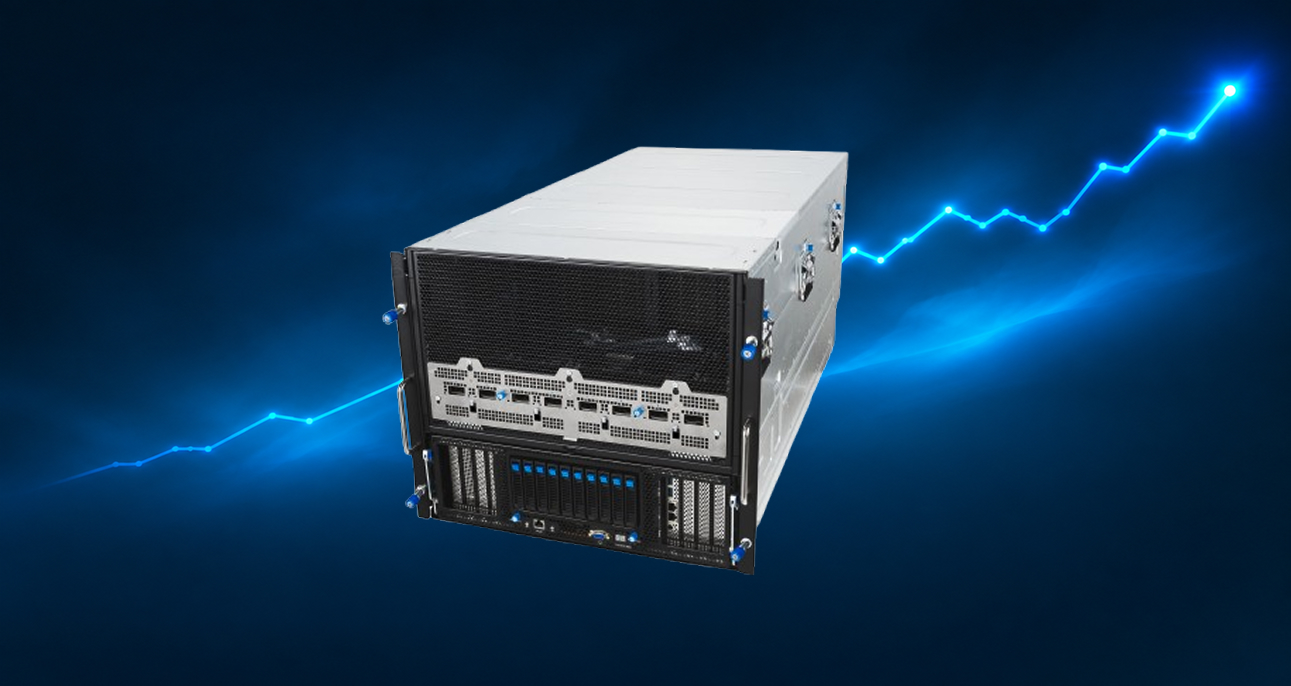
ASUS has established itself among the leading manufacturers in the AI server market, securing multiple first-place results in MLPerf. Equipped with eight NVIDIA Blackwell Ultra GPUs, the ASUS XA NB3I-E12 delivers higher performance than NVIDIA DGX B300 in selected benchmarks. The results demonstrate how ASUS combines NVIDIA's most powerful GPU technology with its own expertise in server design and system optimisation.
ASUS Sets Performance Records in MLPerf
When the MLPerf Inference 6.0 results were published in June 2026, ASUS secured multiple first-place rankings with its HGX B300-based AI server, the XA NB3I-E12. The system achieved leading results with the Llama 3.1 8B and GPT-OSS 120B language models, both in maximum throughput tests and under strict response-time requirements.
MLPerf is a recognised suite of AI system benchmarks developed by MLCommons. These tests make it possible to compare how efficiently different server platforms handle defined AI workloads.
One particularly interesting result comes from the Llama 3.1 8B Server benchmark, which measures performance under varying request patterns and response-time requirements. Here, the ASUS XA NB3I-E12 achieved a throughput of 148,067 tokens per second, compared with 141,565 for NVIDIA DGX B300.
This represents 4.6% higher performance, even though both systems use eight NVIDIA B300 GPUs. ASUS also achieved higher throughput in the Offline benchmark using the same language model.
NVIDIA also highlights the ASUS server in its own overview of MLPerf results. The XA NB3I-E12 is listed with a training time of 6.6 minutes in the Llama 2 70B LoRA benchmark, using eight B300 GPUs. This demonstrates that ASUS is among the manufacturers delivering documented performance results on NVIDIA's most powerful AI platforms.
The results illustrate an important point: GPU platform selection alone does not determine performance. How processors, memory, networking, cooling and software work together also influences how efficiently computing capacity is utilised.
More Than Eight Powerful GPUs
NVIDIA HGX B300 is designed for the most demanding AI workloads, from training and fine-tuning large language models to high-throughput inference. The platform combines eight Blackwell Ultra GPUs with NVLink and NVSwitch, providing high bandwidth between the GPUs.
The ASUS XA NB3I-E12 builds on this architecture with two Intel Xeon 6 processors, support for up to 32 DDR5 memory modules, ten NVMe drive bays and integrated NVIDIA ConnectX-8 networking. The air-cooled 9U server is designed for organisations requiring substantial GPU capacity and the ability to scale AI infrastructure across multiple systems.
However, ASUS has not limited its development efforts to integrating NVIDIA technology into a server chassis. The manufacturer has also invested considerable effort in how the different components of the system are designed and work together.
Purpose-Built Design for Efficient Cooling and Operation
One of the most important design features is the separation of the CPU and GPU sections into two independent sleds with dedicated airflow paths. This allows cooling to be better matched to the workload in different parts of the server. When the GPUs are operating at full capacity, cooling can be concentrated around them without the CPU section necessarily requiring the same airflow – and vice versa.
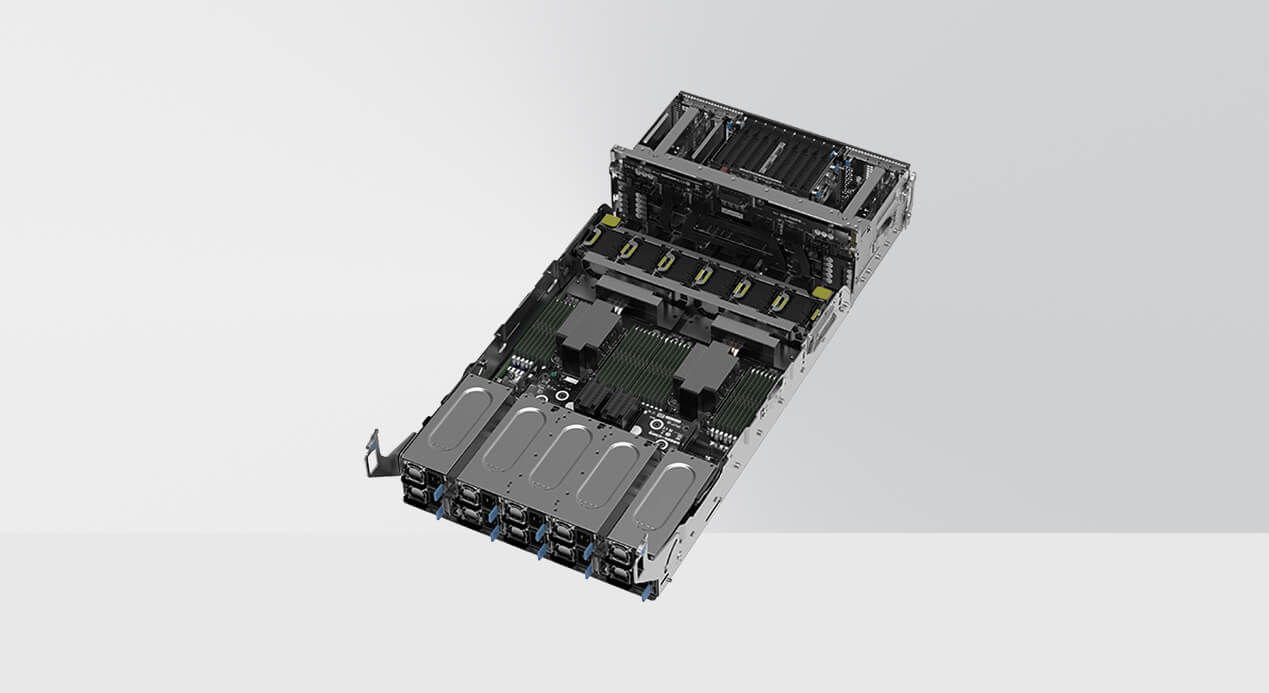
According to ASUS, this design improves thermal management and contributes to lower energy consumption. This is particularly relevant for high-performance AI servers, where cooling and power delivery represent a significant part of the infrastructure.
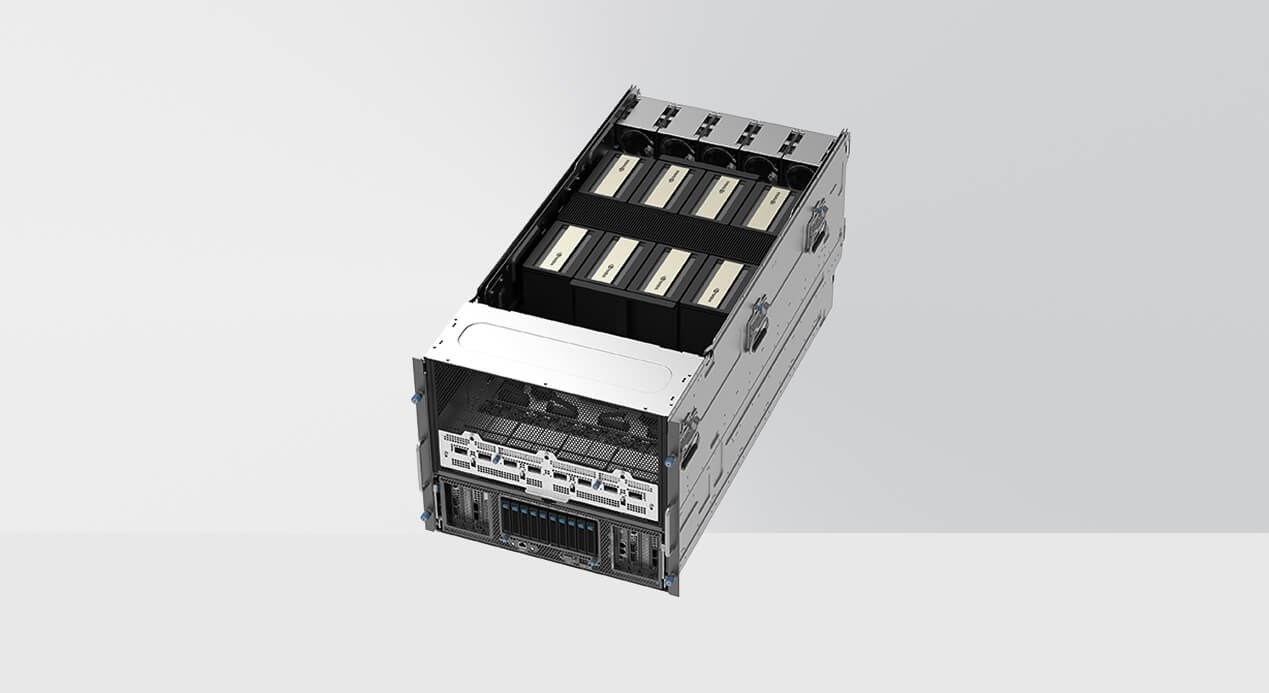
ASUS has also developed a modular design that reduces the need for internal cabling. Direct connections between components allow less restricted airflow through the server while simplifying assembly, troubleshooting and maintenance.
The power system features ten 3200 W modules in a redundant 5+5 configuration. Compared with NVIDIA DGX B300, this provides full redundancy with fewer power supply units and power cables.
The separated cooling architecture, modular construction and power delivery system demonstrate how ASUS has further developed its server design around NVIDIA's HGX B300 platform. The objective is to combine high computing capacity with efficient cooling, reduced energy consumption and easier maintenance.
Proven Performance for Demanding AI Infrastructure
For organisations investing in eight-GPU AI servers, the hardware represents a significant investment. Comparing GPU counts and theoretical computing capacity alone is therefore not sufficient. Performance in real AI workloads, operational stability and the requirements of the surrounding infrastructure are equally important considerations.
ASUS' MLPerf results demonstrate that the company ranks among the leading manufacturers in this performance category. Combined with its purpose-built server architecture, these results reinforce ASUS' position as a supplier of advanced AI infrastructure.
Nextron is a Nordic distributor of ASUS, supplying AI servers and complete system solutions tailored to customer requirements. We help organisations evaluate GPU capacity, system configurations, networking and data centre requirements – from individual servers to larger AI deployments.